Here is the Enigma machine explained without the Hollywood gloss: Nazi Germany trusted its entire war effort to a cipher its own engineers called unbreakable, and a team of mathematicians in a draughty English manor took it apart anyway. This is the Enigma machine explained as an engineering story, how it scrambled messages, why the Germans believed it was bulletproof, and the exact mistakes that let Bletchley Park read their mail.
The Most Expensive “Oops” in Military History
Imagine you have a secret. A really, really important secret. So you buy the world’s most sophisticated lock, a lock so complex that even its makers claim it would take longer than the age of the universe to crack by brute force. You put your secret inside, hand the lock to your soldiers, and tell them to keep it safe.
Now imagine that your soldiers, bless them, occasionally set the combination to “1-2-3” because it’s easy to remember.
That is, more or less, what happened with the Enigma machine. One of the most sophisticated encryption devices ever built. Trusted completely by Nazi Germany to protect every military communication from 1939 to 1945. And read, daily, by a team of mathematicians, crossword enthusiasts, and chess champions working out of a drafty Victorian mansion in the English countryside.
This is the story of Enigma: what it was, how it worked, why it was supposed to be unbreakable, how it got broken anyway, and why every padlock icon in your browser today exists partly because of what happened in a Buckinghamshire field during World War II.
Buckle up. This one’s a ride.
What is the Enigma machine? (The Enigma machine explained for non-spies)
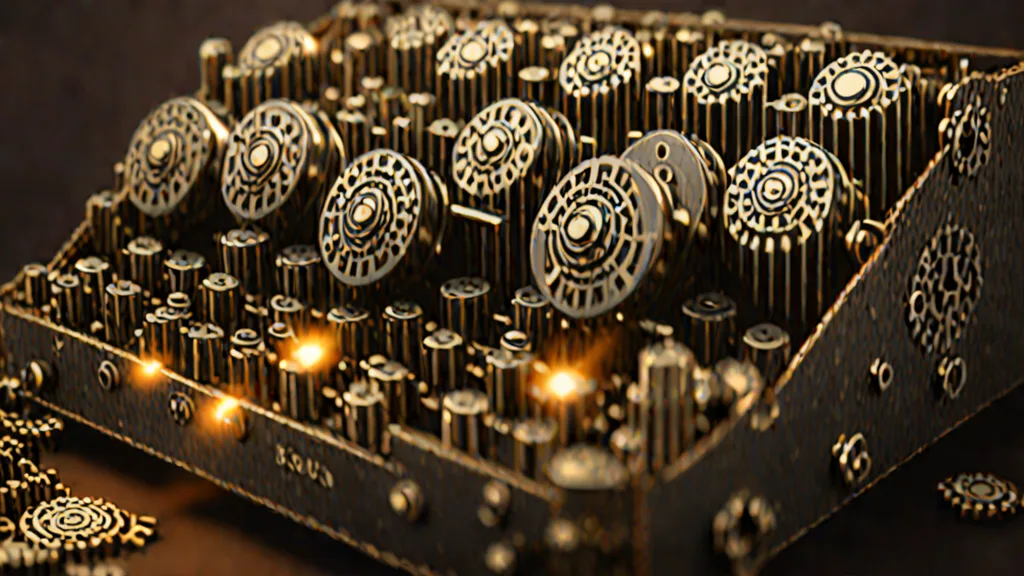
The Enigma machine looks like a typewriter had a baby with a pinball machine. It’s a wooden box roughly the size of a laptop, with a keyboard, a set of glowing letter-lamps, and, this is the clever bit, a series of rotating wheels called rotors inside.
Here’s what it did, in plain English:
You type a letter. The machine scrambles it into a completely different letter. You type another letter. The machine scrambles it again, but differently this time, because the rotors have rotated one position since the last keystroke. Every single letter you type gets scrambled by a different substitution. And the person receiving your message does the reverse: they type the scrambled text into their own Enigma machine (set to matching settings), and the original letters light up.
It’s like if you had a Caesar cipher, the simple “shift each letter by 3” trick kids use, but instead of shifting by 3 every time, you shifted by a different amount for every single letter, and the amounts came from a system so complex that even if someone watched you type the whole message, they couldn’t figure out the pattern.
The Germans were so confident in this system that they used Enigma for everything. Troop movements. U-boat positions. Supply routes. Strategic planning. Every single message, encrypted through this machine, sent over radio, which meant anyone with a receiver could hear it. They just couldn’t read it.
Or so they thought.
How Enigma Actually Worked (The Nerdy Bit, Made Painless)
Let’s go slightly deeper, because the engineering here is genuinely beautiful, and understanding it makes the eventual cracking even more satisfying.
Step 1: The Plugboard (The First Scramble)
Before your letter even reaches the rotors, it passes through a plugboard, a panel on the front of the machine where pairs of letters are swapped with cables. If A is connected to Q, then any A you type becomes Q before anything else happens. Think of it as a warm-up scramble. The plugboard alone gave Enigma over 150 trillion possible configurations.
Step 2: The Rotors (The Main Event)
After the plugboard, your letter enters the rotors, usually three, sometimes five. Each rotor is a disc with 26 electrical contacts on each side, wired internally in a scrambled pattern. Your letter enters one side, gets wired to a completely different letter on the other side, then enters the next rotor, and the next.
After every single keystroke, the rightmost rotor rotates one position, like an odometer. When it completes a full rotation, the middle rotor advances one position. And so on. This means the substitution pattern changes with literally every letter you type. Type “AAAA” and you might get “RTMP” back, four completely different ciphertext letters for the same plaintext letter. Beautiful. Maddening. Both.
Step 3: The Reflector (The Twist)
After passing through all the rotors, the signal hits a reflector, a fixed disc that sends it back through the rotors in the opposite direction. This is what makes Enigma symmetric: the same settings that encrypt a message also decrypt it. Brilliant for field use (no separate decoder needed). But it introduced a critical flaw we’ll get to in a moment.
The Numbers
The total number of possible Enigma settings: approximately 158 quintillion. That’s 158,962,555,217,826,360,000. If you checked one setting per second, it would take about 5 billion years to try them all. The sun will have gone supernova before you finish. The Germans felt pretty good about these odds.
Bletchley Park: Where Britain Sent Its Weirdest People
In 1939, British intelligence recruited the strangest possible team to solve the strangest possible problem. They needed mathematicians, linguists, chess grandmasters, crossword champions, and at least one person who was definitely overthinking things.
They sent them all to Bletchley Park, a Victorian country estate in Buckinghamshire that looked like the setting for an Agatha Christie novel and functioned like a very cold, very secretive university campus. At its peak, over 10,000 people worked there. They called themselves “Station X.” They told their families they worked in a government office. They did not describe the government office in detail. Today it’s a museum, and the Bletchley Park site is worth a visit if you’re ever near Milton Keynes.
The star of the show was Alan Turing, a Cambridge mathematician who was, by all accounts, a genuine eccentric genius. He chained his tea mug to a radiator so nobody would steal it. He cycled to work in a gas mask during hay fever season. He was also, quietly, one of the most brilliant minds of the twentieth century and the person most responsible for the conceptual work that broke Enigma.
Turing didn’t start from scratch. Polish mathematicians, Marian Rejewski, Jerzy Różycki, and Henryk Zygalski, had already made significant inroads breaking early versions of Enigma in the 1930s. They built a machine called the bomba and handed their research to British intelligence just before Germany invaded Poland. That gift of knowledge was arguably one of the most consequential acts of the entire war. It saved months, possibly years, of work.
Turing took their work, understood it deeply, and built something better.
The Four Cracks in the Armour: Why Enigma Was Beatable
Here’s the thing about those 158 quintillion settings: you don’t have to check all of them. You just have to make the problem small enough to be solvable. Bletchley Park found four ways to do exactly that.
Crack #1: The Reflector’s Fatal Flaw
Remember the reflector, the clever device that made Enigma symmetric? It had an unintended side effect: no letter could ever encrypt to itself. If you typed “A”, the output could be anything except “A”. Every single time. Without exception.
This sounds trivial. It is, in fact, enormous.
If Bletchley suspected a message contained the word “WETTER” (German for “weather”, common in meteorological reports), they could immediately eliminate every rotor setting where any letter of WETTER lined up with itself in the ciphertext. That sounds like eliminating a handful of options. In practice, it eliminated the vast majority, reducing the effective search space from quintillions to something a machine could handle.
Crack #2: Predictable Plaintext (The “Crib”)
Military communications are boring, and that’s a feature, not a bug. Messages follow templates. German weather stations sent the same report format every day. Status updates began with the same headers. And, famously, one particularly enthusiastic Luftwaffe officer sent “HEIL HITLER” at the end of every single message.
Bletchley called these guessable words “cribs.” If you could guess a word that appeared somewhere in the plaintext, you could try to align it against the ciphertext and test whether the result was consistent (remember: no letter encrypts to itself, so any alignment where a crib letter matched a ciphertext letter was instantly invalid). A good crib could reduce the search from quintillions to millions, and millions was a number a machine could handle overnight.
Crack #3: The Operators Were Human
Every day, German Enigma operators received a “code sheet” specifying that day’s settings. They were then supposed to choose a random starting position, called the “message key”, and transmit it (encrypted under the day’s settings) at the start of each message.
The problem: humans are terrible at being random. Operators under stress, in the cold, in submarines, in the middle of a war, they defaulted to patterns. “AAA.” “ABC.” Their girlfriend’s initials. Their favourite football team’s abbreviation. “GOD.” One infamous operator allegedly used the same three letters every single day for months.
Bletchley’s analysts catalogued these habits. They called operators with predictable patterns “characters” and looked forward to their transmissions like a favourite TV show. “Oh, that’s Hans again. Hans always uses CIL. We’ll have his message cracked by lunch.”
Crack #4: Early Enigma Repeated the Message Key Twice
Early in the war, German procedure required operators to send the message key twice at the start of every message, a redundancy check meant to catch transmission errors. So if the message key was “XYZ”, the opening of every transmission was “XYZ XYZ” encrypted. Two copies of the same three letters, back to back.
This was cryptographic gift wrapping. It told the Polish and British analysts that positions 1 and 4 encrypted the same letter, positions 2 and 5 encrypted the same letter, and positions 3 and 6 encrypted the same letter. From that structural knowledge, entire categories of rotor settings could be eliminated. The Poles built their original bomba machines specifically to exploit this. Germany eventually changed the procedure in 1940, but by then, Bletchley had enough momentum to adapt.
The Bombe: A Machine Built to Think Faster Than the War
Alan Turing’s master stroke was this: if you can’t check all 158 quintillion settings by hand, build a machine that eliminates wrong settings automatically and stops when it finds a plausible one.
The result was the Bombe, a two-metre-tall, 225-kilogram electromechanical computing machine that sounded like a very angry knitting machine and smelled of hot oil. It was not subtle. It was not quiet. It was, however, extraordinarily effective.
Here’s what it did:
- You fed it a crib: your best guess at a word or phrase in the message
- The Bombe ran through rotor configurations at high speed, testing each one
- For each configuration, it checked whether the crib was consistent with the ciphertext (using the “no letter encrypts to itself” rule to discard invalid ones instantly)
- When it found a configuration that couldn’t be immediately ruled out, it stopped and rang a bell
- Human operators then tested those candidate settings manually
A single Bombe could evaluate millions of possible settings per hour. By 1945, Bletchley Park had 211 Bombe machines running around the clock. The daily Enigma settings, which changed at midnight, were typically broken before noon the next day. Often before breakfast.
This wasn’t a computer in the modern sense. It couldn’t play chess or browse the internet. It was a single-purpose machine built to do one thing: find Enigma settings fast enough to be useful. But the conceptual leap, the idea that you could automate the process of testing hypotheses and eliminating wrong answers, is a direct ancestor of the computer you’re reading this on.
What Bletchley Park Actually Achieved
The intelligence gathered from breaking Enigma was codenamed ULTRA, and it was, for years, the Allies’ most closely guarded secret. The British went to extraordinary lengths to hide the fact that Enigma had been broken, including constructing elaborate cover stories for how they’d obtained certain intelligence.
The impact was enormous:
- The Battle of the Atlantic: U-boat positions were read in near-real-time, allowing Allied convoys to route around them. The German submarine campaign: which came terrifyingly close to strangling Britain’s supply lines, was blunted significantly by ULTRA intelligence.
- North Africa: Rommel’s supply routes were read and targeted. His famous supply problems weren’t entirely bad luck.
- D-Day: German troop dispositions were known in advance. The elaborate deception operation (convincing Hitler the invasion would be at Calais, not Normandy) was partly possible because Bletchley could read German traffic and confirm the deception was working.
- Shortened the war: Historians estimate ULTRA intelligence shortened the war by two to four years and saved an estimated 14 million lives. These are rough numbers, impossible to verify precisely, but the order of magnitude is not seriously disputed.
And all of it remained completely secret until 1974, when the first public account was published. The people who worked at Bletchley Park spent three decades unable to tell anyone, including their own families, what they had done.
Why This Matters for Your HTTPS Connection Right Now
You might be wondering what a 1940s typewriter-with-wheels has to do with the padlock icon in your browser. The answer is: everything.
Every lesson from Enigma’s failure is baked directly into modern cryptography:
Lesson 1: The Maths Can Be Perfect and the System Still Fails
Enigma’s mathematics were genuinely sophisticated. The cipher itself wasn’t weak. The system failed because of how it was used. Today’s TLS encryption, the protocol that powers HTTPS, is designed with this in mind. The key exchange, the session keys, the certificate chain: all designed so that even if an operator is sloppy or a server is misconfigured, the damage is limited. The system is designed to degrade gracefully, not catastrophically.
Lesson 2: Never Reuse Keys
Enigma operators who reused message keys were handing Bletchley Park a gift. Modern TLS uses Perfect Forward Secrecy, a property where each session gets a fresh, unique key that is thrown away afterwards. Even if someone captures all your encrypted traffic and later compromises your server, they can’t decrypt past sessions because the keys no longer exist. This is a direct descendant of the Enigma lesson.
Lesson 3: Patterns Are the Enemy
Cribs worked because military messages were predictable. Modern encryption is designed to produce output that is indistinguishable from random noise, regardless of how predictable the input is. Encrypt the word “HELLO” a million times with different keys and you get a million completely different outputs with no discernible pattern. AES, the encryption standard used in most software today, has this property by design.
Lesson 4: The Next Threat Is Quantum
Here’s the unsettling coda: we may be living through the Enigma moment right now, just from the other side. Today’s encryption is strong against classical computers. But quantum computers, once powerful enough, could break the mathematical problems that RSA and ECDH rely on. The answer, post-quantum cryptography, is already being deployed. Read our guide on Post-Quantum Cryptography with NGINX and Angie for the current state of that story, it’s the Bletchley Park moment of our era, happening in slow motion.
Alan Turing: The Genius Who Got a Terrible Deal
No Enigma story is complete without this part, even though it’s the hardest to tell.
Alan Turing was not just the man who built the Bombe. He laid the theoretical foundations of computer science before computers existed. His 1936 paper on “computable numbers” described the abstract concept of a programmable machine, what we now call a Turing machine, a decade before the first electronic computer was built. His work at Bletchley Park saved an unknowable number of lives. His 1950 paper on machine intelligence introduced what became the Turing Test.
In 1952, he was prosecuted by the British government for homosexuality, which was then a criminal offence. He was subjected to chemical castration as an alternative to prison. He died in 1954 at 41, apparently by cyanide poisoning. The exact circumstances remain disputed.
In 2013, he received a royal pardon. In 2021, his face appeared on the British £50 note.
The country that benefited most from his work spent decades treating him as a criminal for who he was. History’s verdict is rather different.
Frequently Asked Questions
Was Enigma ever truly unbreakable?
As a pure cipher, Enigma was extraordinarily strong for its era, but “unbreakable” was always marketing, not mathematics. The machine had structural flaws (the reflector’s no-self-encryption property) that made it theoretically vulnerable. More importantly, the system surrounding the machine, the operational procedures, the human operators, the predictable message formats, created the gaps that Bletchley exploited. No cipher is stronger than the people using it.
Did Germany ever find out Enigma was broken?
No, not during the war. There were moments of suspicion (particularly around the Battle of the Atlantic, where Allied convoy routing seemed suspiciously good), but German investigators generally concluded Enigma was secure and blamed the intelligence leaks on spies or captured documents. The British went to extraordinary lengths to protect ULTRA, including sometimes allowing attacks to proceed that they could have warned against, to avoid revealing that they were reading German communications. The full story only became public in 1974.
How many Enigma machines still exist?
Roughly 300 Enigma machines are known to survive worldwide, held in museums and private collections. They occasionally appear at auction, in 2017, a Naval Enigma sold for £100,000. The machines themselves are fully functional; the cryptographic settings are what made them secure, not anything inherent to the hardware.
What is the Imitation Game, is it accurate?
The 2014 film The Imitation Game starring Benedict Cumberbatch as Turing is a watchable and moving dramatisation, but it plays very loose with history. Turing did not personally design and build the Bombe alone, Gordon Welchman made crucial contributions the film ignores entirely. The film also compresses timelines dramatically and invents several plot elements. For the real story, visit Bletchley Park itself (now a museum) or read Andrew Hodges’ biography Alan Turing: The Enigma, on which the film was based.
Is modern encryption like TLS vulnerable in the same way Enigma was?
Modern encryption has been specifically designed to avoid Enigma’s failure modes. TLS 1.3 uses perfect forward secrecy (no key reuse), produces output indistinguishable from random (no cribs), and doesn’t have structural properties like Enigma’s reflector. The practical weaknesses in modern cryptography are almost always in implementation and operational security, weak passwords, unpatched servers, human error, not in the mathematics. Exactly the same lesson, repeated eighty years later.
What happened to Alan Turing?
After the war, Turing continued working in computing and artificial intelligence at Manchester University. In 1952 he was prosecuted for “gross indecency” under British law that criminalised homosexuality. He accepted chemical castration rather than prison. He died in June 1954 from cyanide poisoning; his death was ruled a suicide, though some historians have argued it may have been accidental. He was 41 years old. The British government issued a formal apology in 2009 and a royal pardon in 2013. His face now appears on the £50 note.
What’s the connection between Bletchley Park and modern computers?
Very direct. The Bombe was one of the first large-scale automated computing machines. Colossus, built at Bletchley to break the separate Lorenz cipher used by Hitler’s high command, was arguably the world’s first programmable electronic computer. Alan Turing’s theoretical work on computation predated and underpinned all of it. The computing industry grew directly from the soil of wartime codebreaking. Every time you run a search query or open a terminal window, there’s a lineage that traces back to that cold Victorian mansion in Buckinghamshire.
Related Posts
The Enigma story doesn’t end in 1945. The arms race between encryption and codebreaking is still running, and these posts are where it stands today:
- Post-Quantum Cryptography with NGINX and Angie: ML-KEM, Hybrid TLS, and How to Configure It: Quantum computers are to RSA what the Bombe was to Enigma. This is the story of what comes next, and how to configure your server for it today.
- OpenSSL 4.0 for NGINX: Upgrading openssl-nginx from 3.x to 4.0: The encryption library that powers modern HTTPS on your server, explained from scratch with upgrade instructions. The spiritual successor to everything Bletchley Park fought for.
- How to Optimize NGINX and Angie for Maximum Performance and Security: The practical guide to running a fast, secure web server, including TLS 1.3, perfect forward secrecy, and everything else that makes modern encryption hard to break.
Bletchley Park is now a museum and is absolutely worth visiting if you’re ever in the UK: bletchleypark.org.uk. The Bombe replicas are running. Bring a jacket, it’s still cold in there.